
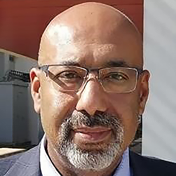
Professor Mohamed Abdel-Maguid is Pro Vice-Chancellor for Education, Student Growth and Global Engagement at Canterbury Christ Church University (CCCU) and a member of the University’s Senior Management Team.
He provides university-wide strategic leadership across education and student success; marketing, admissions and recruitment; global engagement; graduate futures; alumni development, fundraising and philanthropy; lifelong learning; and specialist academic resources and services. This gives him an end-to-end view of the student journey, from initial engagement and admission to graduate outcomes and lifelong connection with the University.
Mohamed’s leadership is grounded in a clear principle: growth is sustainable only when it strengthens educational quality, widens opportunity, delivers a strong return on students’ investment of time, effort and money, and builds long-term institutional resilience. Throughout his career, he has worked to bridge the gaps between STEM, creative practice and the social sciences, creating transdisciplinary environments that nurture innovation, strengthen university-business collaboration, and support applied research and knowledge exchange that benefit communities.
Since joining CCCU in 2020, Mohamed’s portfolio and university-wide accountability have expanded successively through a period of significant institutional transformation. Working with colleagues across the University, he has contributed to the development of a larger, more diverse and increasingly internationally connected university, now serving more than 38,000 students. He has led structural and process change to bring academic and professional services together around the student journey and shared responsibility for outcomes, including academic portfolio reform, selected online provision for UK and transnational education (TNE), stronger partnership quality and student support, changes to assessment and delivery, and more effective use of data in decision-making.
Working with colleagues across the University, the portfolios Mohamed has led have contributed to sustained institutional improvement. CCCU climbed 28 places in The Times and Sunday Times Good University Guide 2026, the highest rise of any university in England, and a further 11 places in the Daily Mail University Guide 2027. It is 5th in the UK for wider student experience, 6th for satisfaction with teaching quality and 2nd in the UK for graduates in employment. In the 2026 National Student Survey, CCCU achieved an overall student positivity score of 89%, four percentage points above the national sector average.
Alongside this institutional leadership, Mohamed’s recent work examines leadership and organisational decision-making in the age of Artificial Intelligence (AI). It considers how universities must rethink graduate professional formation as AI takes on some of the routine cognitive work through which graduates have traditionally developed experience and judgement. His work also explores the risk of “judgement leakage”, where AI-inferred outputs are treated as evidence and recommendations are treated as decisions. He developed the Decision Authority Framework to distinguish between decisions that can appropriately be
automated, those in which evidence should inform professional judgement, and contextual decisions in which human judgement and accountability must remain primary.
Previously, as Pro Vice-Chancellor for STEM and Executive Dean of the Faculty of Science, Engineering and Social Sciences, Mohamed led a university-scale transdisciplinary portfolio. It brought together Christ Church Business School; the School of Engineering, Technology and Design; the School of Law, Policing and Social Sciences; and the School of Psychology and Life Sciences, alongside eight research and innovation centres. Serving more than 25,000 students through direct and partnership provision across the university and partner campuses in the UK and overseas, the Faculty accounted for over 70% of the institution, with responsibility for strategic oversight of a substantial operating budget, financial performance, and long term sustainability.
He led the Faculty’s final REF 2021 submission, representing 112 staff across five Units of Assessment and 55% of the University’s submission. He subsequently reshaped its research and innovation strategy around Society 5.0 and AI-enabled sustainable development, establishing researcher development, mentoring and bidding support for REF 2029. He also led the Verena Holmes Building Board through the commissioning of the £65 million facility during the COVID-19 pandemic and subsequently led further capital projects to modernise the University’s specialist facilities. Together, these projects represented more than £100 million of investment, expanding specialist capacity for education, research and innovation across science, technology, engineering, health and medicine.
Before joining CCCU, Mohamed was recruited as the University’s founding Professor of Engineering, Computing and Technology, and was one of a small number of professors appointed to help build University Campus Suffolk into the University of Suffolk. Serving on the University Executive Team and Board of Directors, he contributed to developing the policies, systems, academic structures and working culture required of the emerging University, including its successful progression to Taught Degree Awarding Powers and University status in 2016.
Alongside this institution-building role, Mohamed held university-wide responsibility for business engagement, regional development, knowledge exchange and applied research across STEAM. As founding Dean, he developed provision across science, engineering, digital and creative disciplines, and the built environment, through the University’s distributed learning network with Suffolk New College, West Suffolk College and East Coast College, while building a transdisciplinary portfolio across education, research and enterprise. He secured more than £15 million in external and industry investment and led major initiatives including the DigiTech Centre at BT’s Adastral Park and the Ipswich Waterfront Innovation Centre. He also contributed to the groundwork towards Research Degree Awarding Powers.
Throughout his career, Mohamed has developed education and institutional partnerships across Europe, the Middle East, Africa and Asia, working with universities, governments, diplomatic missions, industry and education organisations. His approach is based on reciprocity and long-term institutional value, connecting education, research, skills and workforce capability rather than treating internationalisation principally as student recruitment. In 2026, Sri Lankan Prime Minister Harini Amarasuriya recognised his leadership in advancing interdisciplinary transnational education partnerships, widening
access through global collaboration, and strengthening cross-cultural and interfaith engagement.
An engineer and Professor of Smart Systems, Mohamed has more than 30 years’ experience in higher education. His research applies smart technologies and digital transformation across sectors including the built environment, transport, health and security, drawing on expertise in telecommunications, signal processing, artificial intelligence, intelligent systems and the Internet of Things (IoT), with particular interests in Industry 4.0 and Society 5.0. He has supervised more than 25 postgraduate researchers to successful completion, published internationally, and served as a doctoral examiner and professorial assessor. His work has received the Lord Stafford Award for Impact through Innovation and the UHNS Clinical Innovation Award, with finalist recognition from the Times Higher Education Awards and Innovate UK’s KTP Best of the Best Awards.
Mohamed contributes to sector debate through published writing, keynote addresses and panel discussions on higher education, artificial intelligence, professional formation, skills and institutional decision-making, and through forums and task groups at MillionPlus, Universities UK and Advance HE. Earlier in his career, he co-founded and ran private multimillion-pound businesses with direct profit-and-loss responsibility. His executive and non-executive board appointments span education, professional bodies and commercial organisations, including the MENA Board of Quantity Surveyors International; committee responsibilities include finance, resources, risk and audit.
Mohamed’s leadership is visible and coaching-oriented, combining distributed authority with clear accountability. He believes institutions should protect their defining principles and public purposes while remaining willing to redesign how they are delivered. At the heart of his work is a belief that student learning should do more than transmit knowledge and develop a set of competencies: it should build the capabilities people need to learn continuously, exercise sound judgement, create new knowledge and act responsibly under pressure, including when circumstances are unfamiliar and there may be a personal cost to doing the right thing.
Mohamed holds BEng, MSc and PhD qualifications in engineering. He is a Fellow of the Chartered Management Institute, a Fellow of the Institute of Innovation and Knowledge Exchange, and an Honorary Fellow of Quantity Surveyors International.